Top Sonoma County Home Building Trends for 2026
By Dave Keith, CEO, SCB Builders · December 10, 2025 · Construction
As we approach 2026, Sonoma County's home building landscape is evolving rapidly, blending Wine Country charm with innovative designs that prioritize sustainability, wellness, and seamless indoor-outdoor living.
As we move through 2026, Sonoma County's home building landscape is evolving rapidly, blending the region's iconic Wine Country character with innovative, forward-thinking design. With rolling vineyards, coastal influences, and a growing emphasis on resilience amid climate challenges, Sonoma is a hotbed for trends that prioritize sustainability, functionality, and aesthetic harmony with nature. As a third-generation family-owned builder, SCB Builders is excited to share what's shaping the future of homes in our beloved region — and what we're actually seeing from homeowners who are designing and building right now.
1. Sustainability and Eco-Luxury
Sustainability has moved from a differentiating feature to a baseline expectation in Sonoma County. In 2026, we're seeing a strong surge in demand for net-zero and near-net-zero homes — those that minimize or eliminate energy consumption through a combination of advanced insulation, highly efficient mechanical systems, solar arrays with battery backups, and smart energy management.
What's changed is how sustainability gets integrated into the design. A decade ago, sustainable features were often visible add-ons — solar panels as afterthoughts, recycled materials as callouts in the spec sheet. Today's Sonoma homeowners want sustainability baked invisibly into the home: a south-facing roofline that was designed for solar from day one, triple-pane windows specified for both energy performance and acoustic comfort, geothermal systems that quietly condition the house without a trace of mechanical equipment visible anywhere.
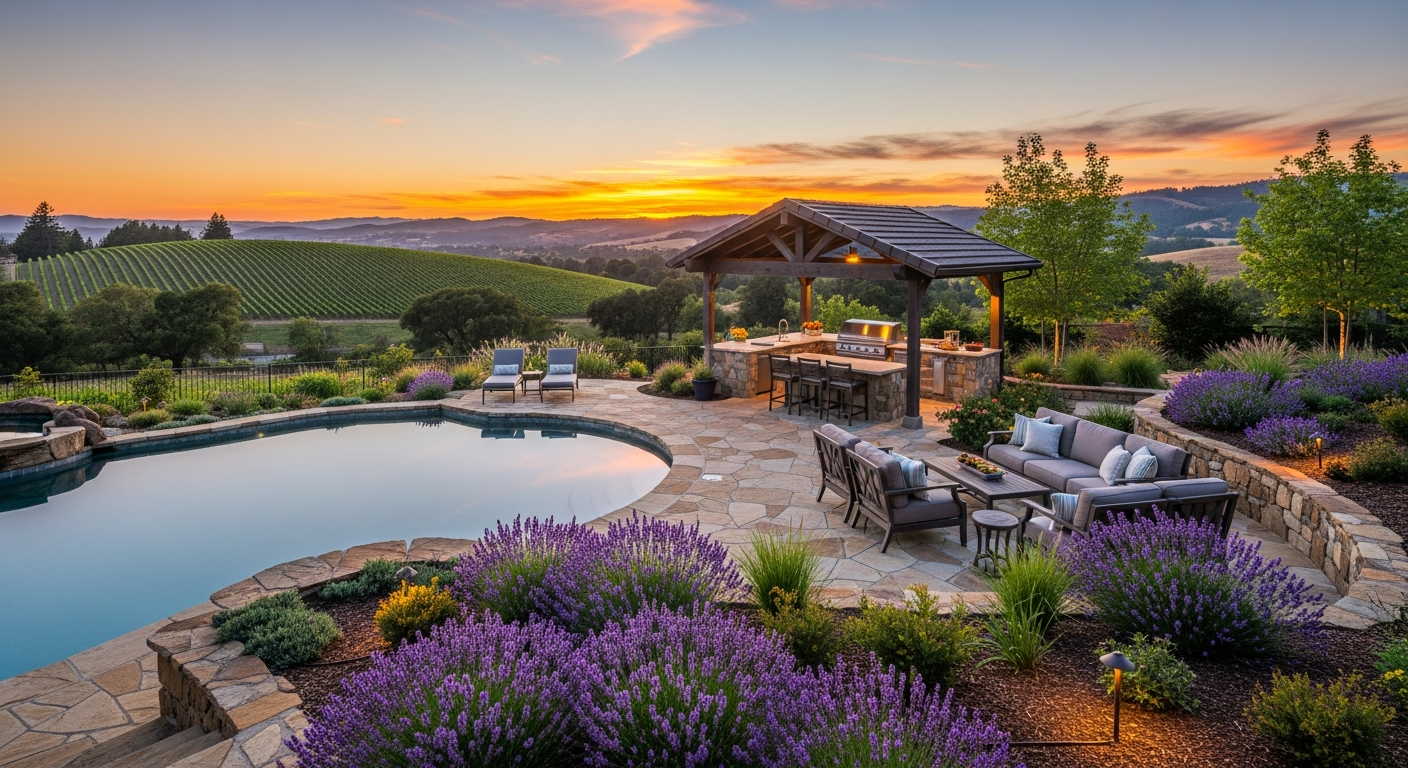
Reclaimed materials play a particularly strong role in Sonoma's eco-luxury aesthetic. Reclaimed local oak for flooring and beams, salvaged wine tank redwood for accent walls and exterior cladding, bamboo and cork as hardwood alternatives — these materials tell a story about place that new materials simply cannot replicate. When a client's kitchen has beams salvaged from a Dry Creek Valley barn, those beams carry a narrative that no amount of design work can manufacture.
Landscaping is increasingly part of the sustainability conversation too. Drought-tolerant native plant palettes, rainwater capture systems, and permeable hardscaping that manages stormwater naturally are all being integrated into site design from the beginning of a project rather than tacked on at the end.
2. Seamless Indoor-Outdoor Integration
Sonoma's mild climate and extraordinary landscape make indoor-outdoor living a perennial priority, but 2026 takes the concept to a new level of sophistication. The best projects we're completing now treat the interior and exterior as a single unified space that simply has different weather characteristics in different zones.
Movable glass wall systems — accordion-fold or telescoping sliding panels that open an entire living room wall to an adjacent patio — are among the most-requested features in new construction and major remodels. When the weather cooperates, the wall disappears entirely. When it doesn't, the view remains. These systems have improved dramatically in energy performance, security, and acoustic performance over the past several years, and the cost premium over standard sliding doors has narrowed.
Outdoor kitchens have moved from a luxury add-on to an expectation in Sonoma County custom homes. The best outdoor kitchen designs we're completing now include pizza ovens with heat shields, professional-grade grills, refrigerated drawers, dedicated wine stations, and stone counters with integrated sinks. These aren't amenities for summer entertaining only — covered outdoor living spaces with radiant heaters, fireplaces, and weatherproof media systems extend the outdoor season to essentially year-round in Sonoma's climate.
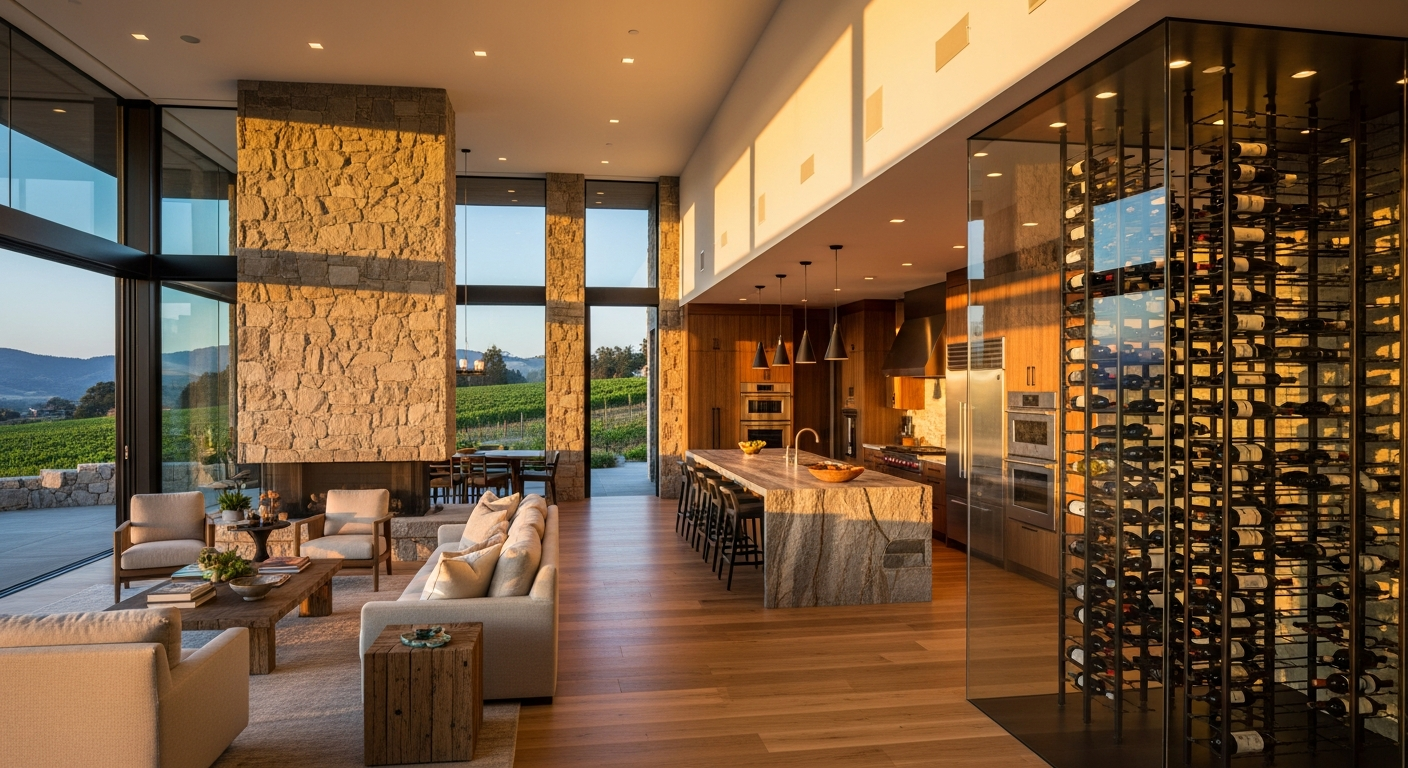
Pool and spa integration is also more sophisticated in 2026. Infinity-edge pools that appear to merge with vineyard views, heated spas that function as year-round wellness features, and pool decks designed in continuous material families with interior flooring create a genuinely seamless spatial experience.
3. Biophilic and Nature-Inspired Design
Biophilic design — the intentional incorporation of natural elements to support human well-being — is one of the strongest trends we're seeing in 2026. The research base supporting biophilic design has grown substantially, documenting reductions in stress, improvements in cognitive function, and faster recovery from illness in spaces with strong natural connections.
In Sonoma County, biophilic design has a built-in advantage: the landscape is extraordinary, and framing it is half the work. Great rooms with floor-to-ceiling glass on the vineyard-facing elevation, bedroom windows positioned to capture the morning light over the hills, bathroom windows that look into a private garden rather than a wall — these are design decisions that cost little extra to implement and deliver enormous value in daily lived experience.
Interior material palettes in 2026 lean strongly toward the natural: raw wood beams, limestone or riven slate floors, earthen plasters, natural fiber rugs, and living plant walls. Color palettes draw from the landscape — sage green, warm terracotta, stone gray, muted ochre — creating spaces that feel like natural extensions of the California environment outside rather than discrete interior environments.
Natural light quality has become a design priority in its own right. Rather than simply maximizing daylight, we're working with homeowners on the character and direction of light — clerestory windows for high indirect light in great rooms, east-facing bedroom windows for morning light, skylights positioned to animate interior walls with moving shadows through the day.
4. Flexible and Multi-Functional Floor Plans
The post-pandemic shift in how people use their homes has permanently changed what clients ask for in Sonoma County. Remote work arrangements that began as temporary have become permanent for large segments of the professional workforce, and home offices are now primary work environments that need to function at a professional level — acoustic isolation, video call backgrounds, ergonomic lighting, separation from household activity.
Multi-generational living arrangements are also driving floor plan requests we didn't see as frequently five years ago. Homeowners in their 50s and 60s are designing for the possibility that aging parents will eventually need to be nearby — whether that means a ground-floor primary suite accessible to a shared pool and garden, a connected wing with its own entrance, or a detached ADU on the property.
Flexible spaces designed to evolve over time — a room that functions as a playroom today, a home office in five years, and a guest room after that — are increasingly common requests. We design these spaces with appropriate ceiling heights, natural light, and door locations to serve multiple purposes over the life of the home.
ADUs remain extremely popular in Sonoma County, driven by both rental income potential and multi-generational living demand. California's streamlined ADU permitting process has made these projects substantially more accessible — we're completing more ADU projects than ever before.
5. Wellness-Centric Features
Health and wellness have become explicit design priorities in Sonoma County custom homes in 2026. Spa-like primary bathrooms with steam showers, infrared saunas, soaking tubs positioned to capture natural light, and radiant floor heating are standard requests in the custom home market. Home gyms with resilient flooring, rubber-mounted equipment bases for acoustic isolation, and dedicated ventilation systems are increasingly expected in homes over a certain size.
Air quality has become a specific focus, particularly in a region where wildfire smoke is a seasonal reality. MERV-13 and higher filtration systems, air purification in primary living areas, and HVAC designs that allow homes to be sealed during smoke events without becoming stuffy are all features we're incorporating as standard practice.
Outdoor wellness features — yoga decks with eastern exposure, meditation gardens, cold plunge pools, and outdoor showers near garden areas — reflect the Sonoma lifestyle in which the boundary between indoor and outdoor wellness practice doesn't really exist.
6. Wildfire Resilience as a Design Principle
After the Tubbs, Kincade, and Glass fires, wildfire resilience isn't a trend in Sonoma County — it's a requirement that every thoughtful homeowner and builder takes seriously. In 2026, we're seeing resilience thinking get integrated into the earliest stages of home design rather than treated as a code-compliance checklist at the end.
This means siting and orientation decisions that consider defensible space from the beginning, material selections that lead with fire-resistance, landscaping plans that are designed as the first line of defense rather than purely decorative, and structural details — eave enclosures, ember-resistant vents, non-combustible deck surfaces — that are designed in rather than retrofitted.
The best-designed fire-resilient homes in 2026 don't look like fortresses. They look like beautiful Sonoma County homes that happen to be built with an intelligent set of materials and details that dramatically improve their chances of surviving a fire event. That is exactly the standard we hold ourselves to at SCB Builders.
Building Your Sonoma County Dream Home
At SCB Builders, we're not just observers of these trends — we're building them, every day, across Sonoma County. Our team brings three generations of local construction knowledge to every project, combined with current expertise in the materials, systems, and design approaches that define what a Sonoma home can be in 2026.
Whether you're designing a new custom home, planning a major remodel, or exploring an ADU, we'd love to talk about how these trends might apply to your specific property and vision.
7. Technology Integration That Doesn't Announce Itself
Smart home technology has matured past the point where it's a novelty. In 2026 Sonoma County custom homes, technology integration is expected — but the expectation is that it work seamlessly and invisibly. Homeowners don't want to manage a dozen separate apps or debug connectivity issues. They want lights, climate, security, and entertainment systems that respond intelligently to how they live and require minimal active management.
The shift we're seeing is toward deeply integrated systems designed from the start rather than bolt-on smart devices added after the fact. When the electrical plan, the lighting plan, and the AV plan are all developed together in the design phase, the result is a home where the technology is invisible — you simply live in the space and it responds appropriately. When smart home features are added after construction, the results are almost always more limited, more expensive to install properly, and more fragile over time.
Specific technology features we're incorporating regularly in 2026 projects: whole-home Lutron lighting control with daylight harvesting (automatic dimming based on natural light levels), Sonos or equivalent distributed audio with in-wall or in-ceiling speakers, automated solar shading on sun-exposed elevations, smart HVAC zoning, and comprehensive security and access control. EV charging infrastructure is now code-required and we integrate it as part of the electrical design from the beginning.
Reliability is as important as capability. We specify systems from manufacturers with proven track records and long parts availability, not cutting-edge technology from companies that may not exist in three years. A home's technology infrastructure should be serviceable for the same 20-30 year horizon as its mechanical systems.
Contact SCB Builders today for a free consultation on your Sonoma County project.
Dave Keith, CEO, SCB Builders