Smart Home Technology Integration in Custom Builds: Sonoma County Trends for Comfort, Security & Efficiency in 2026
By the SCB Builders Team · August 21, 2026 · Custom Homes
Smart home technology has evolved from a luxury add-on to an essential part of well-designed custom homes in Sonoma County. Here's how to plan technology integration during your build or remodel — and why doing it during construction saves significant money and future headaches.
Smart home technology has evolved far beyond novelty gadgets and voice-activated lights. In 2026, a thoughtfully integrated smart home system is part of what separates a well-built custom home from a merely well-constructed one — managing energy costs, enhancing security, supporting wildfire resilience, and making daily life genuinely more comfortable. For Sonoma County homeowners building or remodeling in 2026, the question is no longer whether to incorporate smart technology but how to do it intelligently, durably, and without over-complicating the systems that are supposed to simplify your life.
At SCB Builders, we've seen the full spectrum of smart home outcomes: systems thoughtfully planned during the design phase that work seamlessly for years, and systems bolted on after construction that frustrate homeowners with unreliable connectivity, incompatible platforms, and wiring that wasn't designed to support what was installed. The difference almost always comes down to when the planning happened. Integrating technology during construction — when walls are open and infrastructure decisions are still flexible — costs a fraction of what retrofitting costs later and delivers dramatically better results.
Sonoma County's specific lifestyle and risk environment also shapes smart home priorities in ways that differ from the national conversation. Remote monitoring for second-home owners is genuinely important here, where many Wine Country properties sit unoccupied for extended periods. Wildfire-specific automation — ember detection, automated vent closures, integration with evacuation alerts — addresses a real and persistent risk that homeowners in most other markets don't face. And the combination of large lots, outbuildings, and acreage that characterizes many Sonoma County properties creates whole-property coverage challenges that require robust infrastructure from the outset.
Energy Management and Efficiency
The 2025 California Building Code's push toward all-electric homes makes smart energy management not just a convenience feature but a practical necessity. Heat pump systems, EV chargers, solar panels, and battery storage all generate and consume power in ways that benefit from intelligent coordination. A whole-home energy management system can shift non-critical loads to off-peak hours, prioritize charging when solar production is highest, and provide real-time visibility into consumption by circuit — identifying inefficiencies that would otherwise go unnoticed on a monthly utility bill.
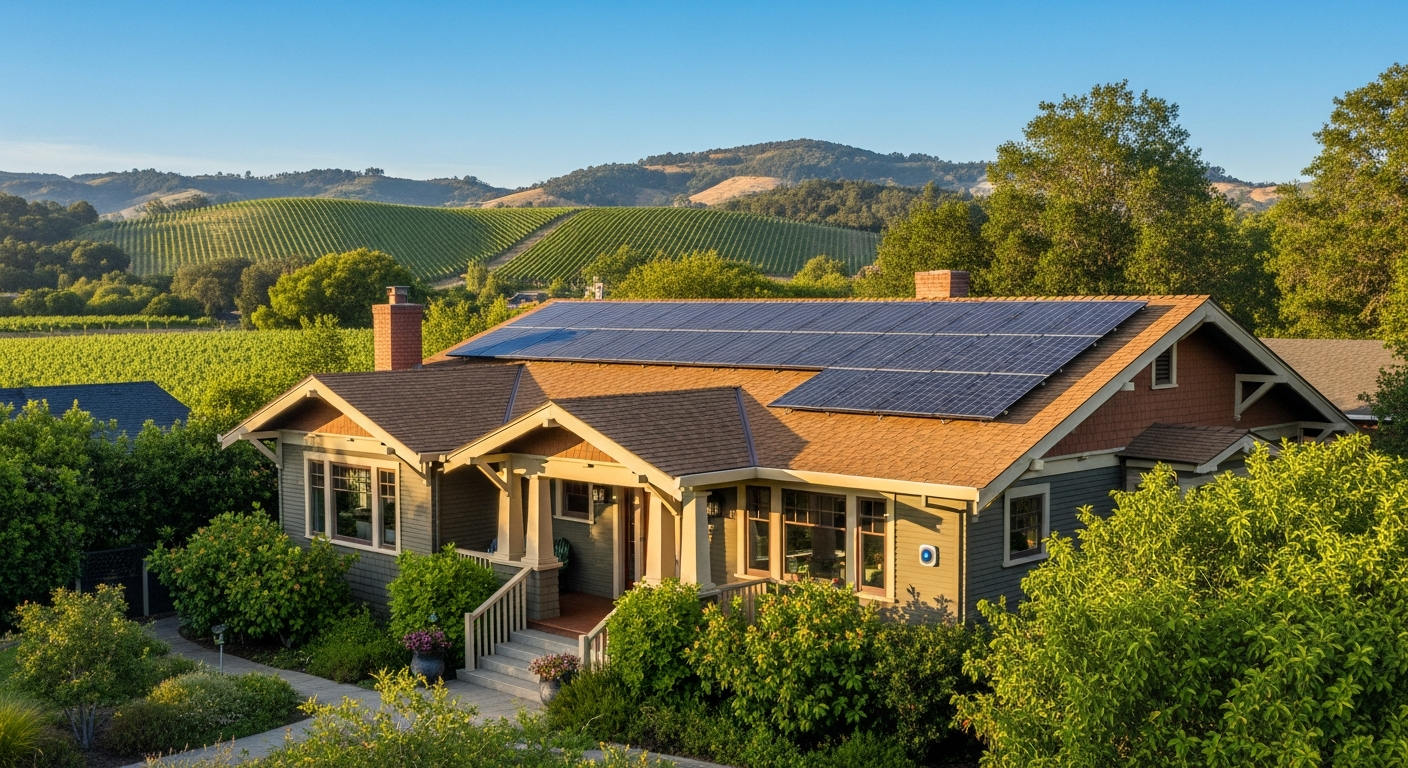
Smart thermostats connected to variable-speed heat pump systems can optimize comfort while dramatically reducing energy use compared to traditional setpoint controls. Automated window shades that respond to sun angle and temperature reduce solar heat gain in summer and retain heat in winter, working in concert with the HVAC system rather than against it. Smart lighting systems that dim and adjust color temperature throughout the day reduce electricity use while supporting occupant wellbeing in ways that traditional switched lighting cannot. For Sonoma County homes with solar panels — increasingly standard in new construction — integration with battery storage systems allows the home to manage grid independence strategically, particularly during PG&E Public Safety Power Shutoff events.
Security and Wildfire Resilience
This category is particularly relevant in Sonoma County, where fire risk is a constant reality and remote property monitoring is a genuine need for many homeowners. A well-designed security and resilience system goes well beyond cameras and alarm panels. Smart smoke and carbon monoxide detectors with immediate mobile notifications ensure that a fire in a vacant property is detected and reported within seconds rather than discovered hours later. Ember and flame detection sensors integrated with automated irrigation systems can provide a meaningful first line of defense during wildfire events when embers arrive before fire crews do.
Automated exterior vent closures — designed to seal against embers during high-wind Red Flag conditions — represent one of the most impactful wildfire resilience features now available for residential construction. Combined with fire-resistant building materials and defensible space, these automated systems address one of the primary ignition pathways identified in post-fire research on Sonoma County home losses. SCB Builders coordinates these installations with the structural framing and exterior detailing during construction, ensuring the mechanical components work with the building envelope rather than compromising it.
Perimeter camera systems, smart locks, video doorbells, and professional monitoring integration complete a comprehensive security package that's especially valuable for properties with acreage, outbuildings, or extended vacancy periods. The key to success in security system design is coverage without complexity — a system that provides complete situational awareness without overwhelming the homeowner with alerts and interface complexity that leads to disabling or ignoring it.
Comfort, Lifestyle, and Whole-Home Automation
Beyond energy and security, smart home automation creates a level of comfort and convenience that transforms daily living in ways that are difficult to fully appreciate until you've experienced them. Multi-room audio systems that follow you from the kitchen to the patio to the master suite, automated irrigation that adjusts to weather forecasts and soil moisture rather than a fixed schedule, pool and spa equipment controllable from your phone while you're still in the car on the way home — these are the features that Wine Country homeowners cite most frequently when describing what they love about their smart home investments.
Kitchen and laundry smart appliances with remote monitoring and diagnostic capabilities, garage doors and gates with smartphone integration, and voice or app control for lighting scenes and climate settings across the entire home all contribute to a living environment that responds intelligently to how you actually use the space. For aging-in-place applications — increasingly important as Sonoma County's population ages — voice-activated controls, automated lighting, fall detection, and medication reminder systems support independence in ways that add genuine quality of life value.
How Technology Integrates During Construction
The best smart home outcomes result from technology planning during the design phase, not after construction is complete. When walls are open during framing, running structured cabling — Cat6 or Cat6A for wired network connections, coaxial for cable and over-the-air antenna, and speaker wire for audio — costs a fraction of what it costs to run after drywall is installed. Conduit runs for future cable management allow system upgrades without opening walls. A dedicated panel or structured media center provides a clean, organized home for networking equipment, security system components, and low-voltage distribution equipment.
Pre-wiring for future expansion is an investment that almost always pays off. Technology evolves faster than homes are remodeled, and the specific devices and platforms you choose today will likely be upgraded or replaced within five to ten years. Infrastructure that's designed for flexibility — conduit rather than direct-buried cable, generous panel space, PoE (Power over Ethernet) capability for cameras and access points — means future upgrades can happen without major disruption. Platform selection matters too: systems built around open standards and widely supported platforms (Apple HomeKit, Google Home, Amazon Alexa, or professional-grade systems like Control4 or Lutron) are easier to upgrade and support than proprietary systems that lock you into a single vendor.
Cost Considerations for Smart Home Integration
Budget ranges for smart home integration vary enormously based on scope and brand preferences. A basic package covering smart thermostats, automated lighting in key rooms, and a video security system might add $5,000 to $15,000 to a construction budget. A mid-range package that adds whole-home audio, comprehensive security coverage, and full lighting automation across the home typically runs $20,000 to $50,000. A comprehensive whole-home system with professional-grade automation, robust security infrastructure, theater room, and fully integrated energy management can reach $75,000 to $150,000 or more for large properties.
Many homeowners find that the long-term savings and benefits partially offset the upfront cost. Some homeowners insurance carriers offer premium discounts for professionally monitored systems with specific detection capabilities. Energy management systems can meaningfully reduce utility costs in all-electric homes with solar and storage. And resale value — particularly in the premium Wine Country market where buyers increasingly expect modern technology infrastructure — reflects the quality and capability of a well-integrated smart home system. SCB Builders coordinates with trusted technology integrators who understand both the technical requirements and the aesthetic expectations of Wine Country homeowners. Contact us at (707) 546-2228 or visit scbbuild.com/contact to discuss smart technology integration in your upcoming project.